Most people already practice EDC without calling it that. Keys in one pocket, phone in the other, wallet somewhere in the bag. The difference between that and a real everyday carry setup is intention. EDC is not about carrying more. It is about carrying the right things, organized in a way that works when you actually need them.
This guide covers what EDC gear means, what belongs in a solid kit, and how to build one that you will carry every day without thinking about it.

What Is EDC Gear?
EDC stands for Everyday Carry. EDC gear is the collection of items a person carries consistently. Not occasionally, not when they remember, but every single day.
The concept emerged in the early 2000s through online communities where military, law enforcement, and outdoor enthusiasts started sharing what they carried and why. It has since expanded into a much broader community, but the core logic has not changed: the gear on your body when something goes wrong is the only gear that counts.
EDC gear meaning in practice: every item earns its place through regular use. A tourniquet that sits in your kit for a year without being used still earns its place. A gadget you pick up twice a month does not.
EDC enhances self-sufficiency and preparedness by giving you the tools to manage minor emergencies, solve everyday problems, and handle unexpected situations without depending on what is around you.

What Does EDC Actually Cover?
There is no fixed list. EDC is personal and built around your job, environment, and daily routine. A law enforcement officer's everyday carry looks nothing like an office worker's, and both are valid. What they share is the same logic: compact, durable, immediately accessible, and useful across more than one situation.
Core EDC items most people start with: a smartphone, wallet, keys, and a flashlight. From there, a knife or multitool, a power bank, a pen, and a small medical kit round out a functional setup. Everything beyond that depends on what you actually encounter.
The broad categories most EDC kits cover:
- Cutting tool (knife or multitool)
- Light source (dedicated flashlight)
- Communication and power (phone, power bank, cables)
- Documentation and payment (wallet, ID)
- Carry system (what organizes and holds everything)
- Medical (at minimum a basic first aid kit or IFAK)
- Writing (pen, pocket notebook)
- Utility (zip ties, carabiner, paracord, keys)
Not every kit needs every category. The goal is covering what you actually need, not building a survival loadout for a commute.
Must-Have EDC Gear: The Core Categories
Knife
A pocket knife is considered the cornerstone of an EDC setup, and for good reason. A reliable knife gets used multiple times daily: opening boxes, cutting packaging, preparing food, trimming loose threads, field repairs. Most users who track their knife use are surprised how often it comes out.
EDC knives typically keep blade length in the 2.5 to 3.5 inch range, compact enough for pocket carry, within legal limits in most areas, and sufficient for everyday tasks. The Benchmade Bugout is a frequently referenced example: 3.24-inch drop point blade, 1.85 oz, AXIS lock, and a deep-carry pocket clip. It is compact and light enough to forget it is there until you need it.
What to look for: a reliable locking mechanism, a pocket clip or belt loop attachment, and a blade length that is legal where you live and work.

Multitool
A multitool combines several tools into one compact device, typically pliers, screwdrivers, a blade, wire cutters, and a file. For situations where a knife alone is not enough, a multitool adds range without adding a second pouch to your kit., screwdrivers
The Leatherman Wave+ is one of the most widely recommended options in the EDC community. It covers the most common tool needs in a form factor that fits a belt pouch or bag pocket. For lighter carry, smaller keychain multitools handle basic utility tasks without the weight of a full tool.
Most EDC kits include both a dedicated knife and a multitool. The knife handles fast cutting tasks. The multitool handles everything else.

Flashlight
A compact flashlight is essential for everyday carry. A phone flashlight has no throw, washes out in daylight, and drains your battery doing it. A dedicated EDC light runs 300–1000 lumens, operates with one hand, and clips to a pocket or bag strap.
The Streamlight Microstream is a frequently referenced compact option: 3.6 inches long, 1.1 oz, single AAA battery, 45 lumens output with a 41-meter beam and 2.25-hour runtime. The rechargeable USB version steps up to 250 lumens on high. For most everyday life use, 45–250 lumens covers the range. For patrol, outdoor, or tactical use, go higher and look at dedicated duty lights.
Look for a tail switch or side switch that works one-handed and a clip or keychain loop for consistent carry position.

Power Bank and Connectivity
A power bank charges mobile devices away from an outlet. It is one of the most-used items in a modern EDC kit. A flat 5000–10000mAh bank fits in a back pocket or EDC pouch and covers one to two full cell phone charges.
Short charging cables, 20 to 30cm, take up almost no space and remove a daily friction point. Keep a USB-A and USB-C cable together in a small organizer inside your carry pouch. If you work across multiple devices, add an adapter rather than carrying multiple cables.

Wallet
Carry what you actually use. A slim wallet with two to four cards and cash beats a thick billfold that makes sitting uncomfortable and takes 20 seconds to navigate. Minimalist EDC setups treat the wallet as a carry item, not a filing system. Keep only cards you use daily, cash, ID. Nothing else.
Pocket carry wallets in Cordura or technical fabric stay flat, do not stretch the pockets of tactical pants, and hold their shape under daily use. Tactical card holders in the same materials often add a D-ring or belt loop attachment for clipping to a bag.

Medical
This is where most civilian EDC setups stop short. A first aid kit with bandages and antiseptic ointment covers minor injuries and is worth carrying for that alone. Cuts, scrapes, and small burns happen regularly and a basic kit addresses them before they become a bigger problem. A compact kit should include bandages, Neosporin or equivalent antiseptic ointment, and medical tape at minimum.
For a more complete setup, an Individual First Aid Kit (IFAK) is recommended. An IFAK adds a tourniquet, compressed gauze, and a chest seal: the items that address life-threatening bleeding and chest injuries in the time before emergency services arrive. A CAT or SOFTT-W tourniquet and a Z-fold compressed gauze fit in a small pouch that attaches to a belt or bag.
First aid supplies help manage injuries before professional help arrives. Carrying gear you are not trained to use is dead weight. Prioritize basic first aid training first, then expand the kit to match your skills.

Pen and Notebook
A pen gets used more often than most EDC items. Forms, contact info, field notes, quick sketches. Writing by hand is faster than navigating a phone in many situations, and a phone needs power to work.
Field Notes notebooks are among the most popular choices in the EDC community for their compact size (3.5" x 5.5"), durable cover, and ruled or grid paper. A metal-body pen like the Fisher Space Pen or Zebra F-701 survives pocket carry and works in cold or wet conditions.

Utility Items
Zip ties, a small carabiner, a length of paracord, and a few elastic bands sit in a corner of an EDC pouch and earn their space through regular use. Zip ties fix a range of problems fast. Paracord replaces a broken strap, laces a package closed, or marks a position.
Keys belong on a key organizer or proper keychain that prevents them from scratching your phone and makes the right key fast to find. A small carabiner clips the keychain to a bag or belt loop so keys stop going missing at the bottom of a bag.

How to Carry EDC Gear
Pocket carry is the starting point. Keys, phone, wallet, knife, and flashlight fit in the pockets of most tactical pants and everyday clothing. The limitation is organization. Pocket carry puts everything in together, and finding what you need quickly requires a consistent pocket assignment for each item.
An EDC pouch solves this. A small organizer pouch on a belt loop or inside a bag gives every item a fixed slot. You reach for it the same way every time, which matters under stress.
Belt carry works for items that need immediate access: a knife clipped to the front pocket, a multitool on a belt holster, a flashlight clipped to a strap. It keeps critical tools at hand without going into a bag.
A waist pack or fanny pack expands capacity without committing to a full backpack. It handles a phone, wallet, keys, flashlight, small medical kit, and utility items in an organized format that stays accessible. M-Tac waist packs run on adjustable straps for waist and crossbody carry, with YKK zippers, MOLLE straps for expansion, and optional CCW compartments for concealed carry users.
A sling bag or shoulder bag covers a full EDC kit plus a water bottle, documents, and extra items. The M-Tac EDC Bag Elite includes a built-in organizer panel, a dedicated CCW compartment with ambidextrous quick-release, and a rear smartphone pocket.
A backpack works for extended carry: a full medical kit, water bottle, tools, cables, a change of clothing. For most daily use, a backpack is more than the situation requires. Use one when the day demands a larger kit.

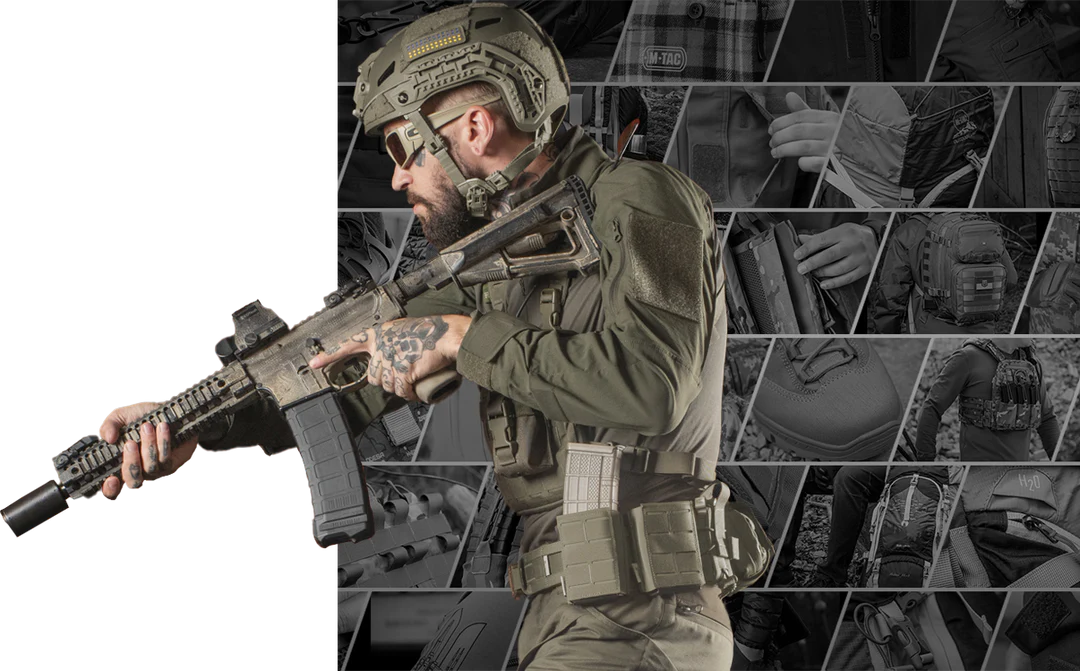
Tactical EDC Gear: What Changes for Military and Law Enforcement
Tactical EDC gear covers the same categories but at a higher standard on each item.
Medical moves from optional to required. A tourniquet goes on the body every day, not in a bag in the car. The kit extends to a full blowout setup: tourniquet, chest seal, compressed gauze, and a decompression needle for trained users. An IFAK is the baseline, not the ceiling.
The carry system matters more. Off-duty law enforcement and military personnel need a bag or pouch that provides fast access to a sidearm without drawing attention. M-Tac bags with dedicated CCW compartments and quick-release systems handle this. Fast access without printing through the bag, in left- and right-hand configurations.
Utility gear expands to include a fixed-blade knife alongside the folding knife, paracord in longer lengths, and a flashlight in the 500–1000 lumen range for outdoor and low-light environments.
MOLLE compatibility throughout the carry system lets you add or remove pouches as the mission changes without replacing the base kit.

How to Build Your EDC Kit Without Overdoing It
Minimalist EDC setups emphasize carrying only items that are genuinely useful. The test for every item: does it solve a problem you actually encounter, and does it do it better than something already in your kit?
Start with cutting, light, and carry system. Add medical when you have completed basic first aid training. Add utility items as you identify real gaps in your daily routine. The best EDC kit is the one you carry every day, not the most comprehensive one you leave at home because it is too heavy.
Bulk is the enemy of EDC. Every item should be compact and attached or organized so nothing shifts during the day.
Personalizing EDC gear allows it to reflect individual needs and carry preferences. Someone who commutes by bike has different requirements than someone who works outdoor patrol shifts. The categories stay the same; the specific items inside them change.
EDC vs Survival Gear
EDC and survival gear overlap but they are not the same thing.
Everyday carry covers what you need on your person for a normal day, with room to handle unexpected situations: a medical issue, a mechanical problem, a power outage. The timeframe is hours.
Survival gear covers extended self-sufficiency: shelter, fire, water filtration, navigation, food. That kit lives in a bag in the car or at a base location. It is not what goes on your belt for a workday.
The confusion between the two produces EDC kits that are too heavy to carry consistently. A tourniquet and a quality knife belong in EDC. A full fire kit and a water filter belong in a vehicle bag or go-bag.

EDC Carry Gear from M-Tac
If your carry system is the weak point in your kit, M-Tac covers the full range.
- For belt and body carry, the waist pack lineup includes the CCW Gen. II and Companion series. Both run on adjustable straps for waist or crossbody carry, use YKK zippers and Woojin hardware, and are MOLLE compatible for adding pouches. Select models include a dedicated CCW compartment with fast access.
- For a more complete kit, the EDC Bag Elite and Cube Bag handle daily carry with organized internal compartments, a built-in CCW section with quick-release access, and MOLLE panels on the exterior. Both are designed for people who carry more than a wallet and a phone.
- Utility pouches and admin pouches mount on a belt, shoulder strap, or plate carrier via MOLLE or Laser Cut panels. They keep tools, cables, medical supplies, and small items accessible without digging through a main compartment.
- Tactical wallets in Cordura keep cards and cash flat and accessible in a front pocket or pouch. Several models include a D-ring or belt attachment for clipping to a bag.
- Bag inserts and organizers let you customize the interior of any bag for your specific kit layout, including holster inserts for CCW users.
Final Thoughts
A good EDC kit does not happen in one purchase. It builds over time as you figure out what you actually reach for and what takes up space for nothing.
Start with the basics: a knife, a light, and a carry system that fits your daily routine. Add medical once you have done basic first aid training. Fill in utility items as you identify real gaps. Every item that does not get used regularly is a candidate for removal.
The goal is a kit that goes with you every day without feeling like a burden. If it stays home because it is too heavy or too bulky, it is not EDC. It is just gear.